


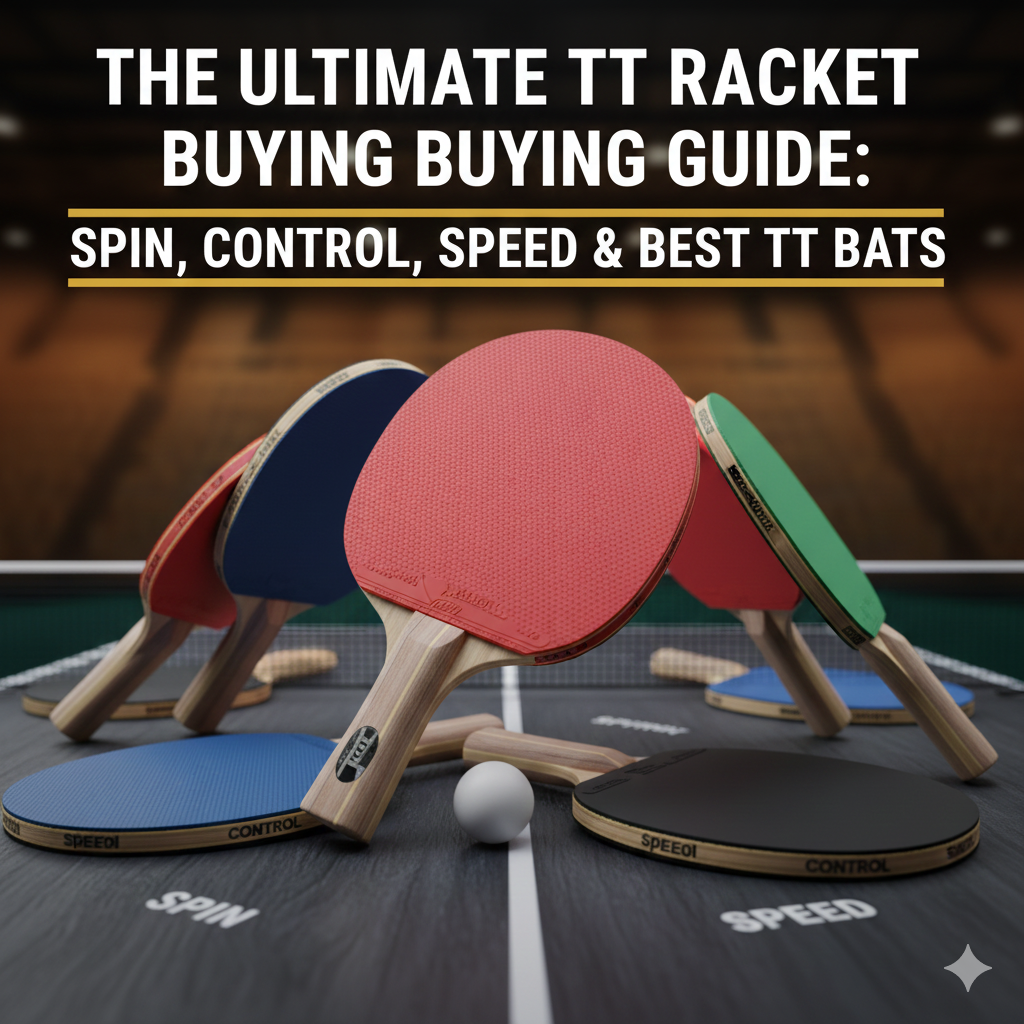
The Ultimate TT Racket Buying Guide: Spin, Control, Speed & Best TT Bats
Posted on: 25 Nov, 2025
Whether you're a beginner learning your first forehand or an advanced player dominating tournaments, one thing decides your performance more than anything — your TT racket (TT bat).
Most players buy a racket only based on brand or price, but table tennis is a game of precision. The right combination of spin, speed, and control can completely transform how you play.
This guide breaks down everything you need to know before buying a TT racket — from blade materials to rubber types to playstyle recommendations. By the end, you’ll know exactly which TT bat suits your skill level and game style.
1. Understanding the Three Core Elements: Spin, Speed & Control
Your TT racket’s performance depends on the balance between these three elements:
Spin
If you enjoy topspins, backspins, slices, or deceptive serves — you need a racket that grips the ball well.
A high-spin TT racket gives you:
- Better serve variations
- Stronger topspin rallies
- More control during defensive chops
Rubber with a tacky or grippy surface gives maximum spin.
Speed
Speed determines how fast the ball shoots off your racket.
A high-speed TT racket is ideal for:
- Offensive players
- Quick rallies
- Fast smashes
- Aggressive topspin shots
Blades with carbon layers or stiffer wood give more speed.
Control
Control is how accurately you place the ball. Beginners especially need this.
A high-control TT bat helps:
- Reduce errors
- Place shots precisely
- Build consistency
- Improve defensive play
Soft rubbers and flexible blades increase control.
2. Blade Types: Which One Should You Choose?
The blade is the heart of the TT racket. There are two main types:
A. All-Wood Blades
Best for control and spin.
Benefits:
- Better feel
- Great for beginners
- Perfect for defensive play
- More consistent touch
Ideal for:
Beginners to intermediate players who want better control.
B. Carbon or Composite Blades
Made with layers of carbon fiber.
Benefits:
- Higher speed
- Larger sweet spot
- More stability
Ideal for:
Advanced players or aggressive hitters.
3. Rubber Types: The Real Game-Changer
Your rubber will decide how much spin, speed, and control you actually get.
A. Inverted Rubber (Most Popular)
Smooth surface, high spin.
Used by 95% of professional players.
Best for:
All-rounders, attackers, and beginners.
B. Pimpled (Pips-Out) Rubber
Little spikes on the surface.
Benefits:
- Fast shots
- Disrupts opponent’s spin
Ideal for:
Aggressive close-to-table players.
C. Long Pips Rubber
Taller pips that reverse spin.
Best for:
Defensive choppers and spin blockers.
4. Sponge Thickness — Don’t Ignore This!
The sponge is the layer between blade and rubber.
👉 1.0–1.8 mm: More Control, Less Speed
For beginners and defensive players.
👉 1.8–2.1+ mm: More Speed, More Spin
For intermediate and advanced players.
5. Handle Types — Choose What Feels Right
TT rackets come in 3 handle shapes:
1. Flared (FL)
Wider at the bottom.
Most common and best for comfort.
2. Straight (ST)
Uniform grip.
Good for players who switch between backhand/forehand often.
3. Anatomic (AN)
Bulged center for a natural grip.
Favors players who like stronger hand stability.
6. What’s Your Play Style? Pick the Right TT Bat
Choosing a TT racket depends heavily on your playing style:
A. Offensive (Attacking) Players
Look for:
- Carbon blade
- Fast rubber
- 2.0+ mm sponge
Best for:
Smashing, topspin attackers, power players.
B. All-Round Players
Look for:
- All-wood or light composite blade
- Balanced speed & spin rubber
- 1.8–2.0 mm sponge
Best for:
Players mixing attack & defense.
C. Defensive Players
Look for:
- All-wood flexible blade
- High-control rubber
- Thin 1.0–1.5 mm sponge
- Possibly long pips on backhand
Best for:
Choppers, blockers, counterplayers.
7. Should You Buy a Pre-Assembled or Custom TT Racket?
Pre-Assembled TT Rackets
Ready to use, suitable for beginners.
Pros:
- Affordable
- Good for early learning
- Balanced features
Custom TT Rackets
Choose your own blade + rubber combo.
Pros:
- Better performance
- Long-term investment
- Perfect match for your style
Best for intermediate and advanced players.
8. Signs You Need a New TT Racket
You’ve outgrown your beginner racket
- Rubber has become flat or smooth
- Blade vibrates too much
- You can’t generate enough spin
- You feel lack of control or stability
Upgrading your TT bat improves your game instantly.
9. Why Buying from a Quality Brand Matters
A high-quality TT racket ensures:
- Better durability
- Consistent bounce
- Long-lasting rubber life
- True speed & spin ratings
- Professional performance
Koxtons offers TT bats built with performance-grade materials ideal for all levels — beginners to competitive players.
Conclusion
Choosing the right TT racket or TT bat can completely change how you play. Whether you’re looking for more spin, better control, or faster gameplay, understanding the blade, rubber, sponge thickness, and handle type is essential.
Instead of picking randomly, invest in a TT racket that matches your style — and you’ll see your performance improve instantly.
A good racket doesn’t just help you play better…
It helps you love the game more.
FAQs
Q: Which TT racket is best for beginners?
A: Beginners should choose a lightweight TT racket with balanced speed and control, usually an ALL or ALL+ category bat.
Q: Does racket rubber really affect my game?
A: Yes, rubber decides your spin and speed. Softer rubbers give better control, while harder rubbers offer more power.
Q: How do I select the right blade for my playing style?
A: Defensive players choose slower blades, while attackers prefer OFF or OFF+ blades for extra speed.
Q: What’s the ideal weight of a TT racket?
A: 160–180 grams is ideal for most players. Heavy bats give more power; light bats give quicker response.
Q: How often should I replace my TT racket rubber?
A: Regular players should replace rubber every 3–6 months, depending on usage and playing intensity.
Q: Are pre-made TT bats good?
A: Yes, for beginners. Advanced players prefer customizable rackets for better spin and speed control.
Q: Is a TT bat with more spin better?
A: Not always. High-spin rubbers require skill. Beginners should prioritize control over spin.
Recent Posts
-
 KX-10008 Table Tennis Table (Club Series) 30 Mar, 2026
 -
-
-


Comments
No comment yet.