


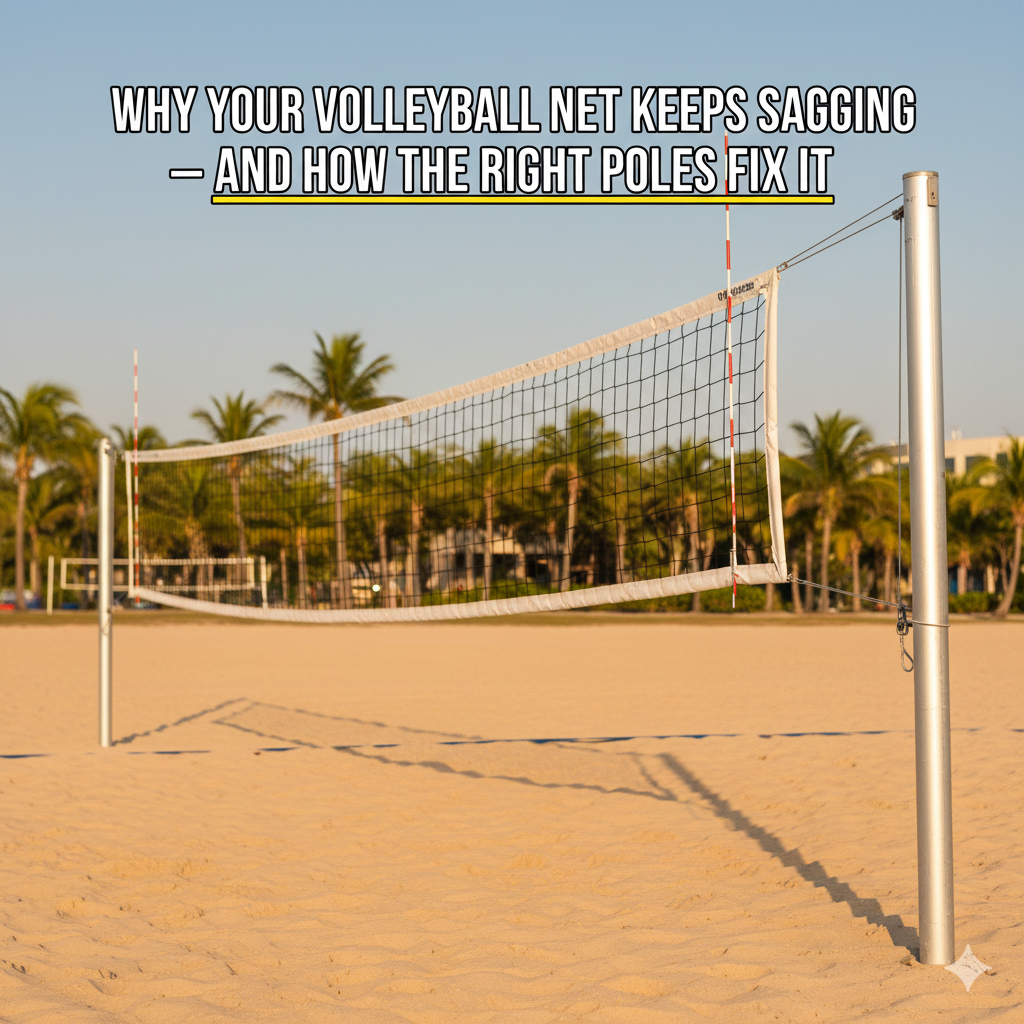
Why Your Volleyball Net Keeps Sagging — And How the Right Poles Fix It
Posted on: 25 Nov, 2025
A sagging volleyball net is one of the biggest frustrations for players, coaches, and even school sports coordinators. It ruins the game flow, affects fairness, and makes every rally unpredictable. But here’s the good news — the problem isn’t always the net itself.
In most cases, the real issue lies in the poles, tension system, or the way the setup is installed.
Whether you’re using a volleyball net for training, tournaments, school events, or backyard play, understanding the cause of sagging is crucial. This guide explains why your net keeps drooping — and how the right volleyball poles and accessories can completely fix it.
1. The #1 Reason: Weak or Low-Quality Volleyball Poles
Most people think the net is at fault, but actually weak poles cannot maintain tension, causing the net to sag within minutes.
Why weak poles fail:
- They bend when tension increases
- They can’t hold regulation height
- They’re not stable on soft ground
- They loosen with movement or wind
How to fix it:
Use heavy-duty, rust-resistant, thick-gauge steel poles that stay firm even during aggressive gameplay.
The stronger the pole, the tighter your net stays — simple.
2. Poor Tension Mechanism = Instant Sagging
Even a premium net will sag if the tension mechanism is faulty.
Common issues:
- Old hooks
- Loose clamps
- Cheap ropes
- Poor-quality pull-through rings
Solution:
- Choose a volleyball pole system with:
- Adjustable tension hooks
- Strong rope or cable systems
- Locking clamps
- Proper anchoring
This ensures the net stays tight from end to end.
3. Using the Wrong Type of Volleyball Net
Yes, net quality matters.
Low-quality nets sag because:
- The top tape loosens quickly
- Side tapes don’t support tension
- The mesh stretches
- Cable or rope on the top is weak
Fix:
- Choose a volleyball net with:
- Strong steel cable or thick rope at the top
- Double-stitched side tapes
- UV-resistant mesh
- Heavy-duty edging
This combination ensures long-lasting tightness.
4. Incorrect Pole Distance or Setup
If your poles are either too close or too far apart, the net will never sit right.
Standard volleyball court measurement:
Poles must be 9m (approx.) apart for a perfect fit.
If wrong distance is used:
- Net droops
- Mesh stretches
- Tension becomes uneven
- Top cable can break
Fix:
Always follow regulation measurements — or use adjustable nets designed for multiple court sizes.
5. Loose Ground Anchoring
Even strong poles become useless if the anchoring is poor.
Common problems:
- Poles shift during play
- Base wobbles
- Soft soil or sand loosens the pole
- Incorrect base weight
Solution:
Use:
- Proper ground sleeves
- Weighted pole bases
- Deep anchors for outdoor setups
- Anti-movement stabilizers
This keeps your poles firm and the net perfectly stretched.
6. Not Using Antenna or Side Tension Supports
Antenna and side tapes are crucial for holding net shape.
Without these, nets sag because:
- Side tension is uneven
- Net edges collapse inward
- Top cable can’t hold weight alone
Fix:
Use a setup with:
- Antennas
- Side tension straps
- Reinforced corner loops
These small accessories make a huge difference.
7. Weather Conditions Affect Low-Quality Nets
Outdoor nets stretch faster due to:
- Sun
- Rain
- Wind
- Humidity
Weak materials expand and contract, creating sagging.
Fix:
Use UV-coated, weather-resistant volleyball nets and galvanized or powder-coated poles suitable for outdoor conditions.
8. Old Nets Lose Shape Over Time
Just like any sports equipment, nets stretch and weaken.
Signs your net is too old:
- Mesh looks loose
- Top cable visibly bends
- Tapes look worn
- Frequent sagging even after tightening
Fix:
Upgrade to a new high-quality net — ideally one with steel cabling for long-term tension.
How the Right Volleyball Poles Fix All These Problems
Strong and well-designed poles solve the root cause of sagging by providing:
✔ Proper height stability
✔ Strong vertical support
✔ Even cable tension
✔ Long-lasting durability
✔ Zero bending under pressure
A tight, professional-level volleyball setup always begins with the right poles — not just the right net.
Conclusion
If your volleyball net keeps sagging, don’t blame the net first. The real issue often lies in weak poles, loose tension systems, improper installation, or low-quality accessories.
By choosing strong volleyball poles, durable nets, and proper ground anchoring, you can enjoy a tight, professional setup every time — whether at school, clubs, tournaments, or backyard games.
For the best results, always invest in high-quality volleyball nets and accessories that maintain tension and last longer under tough play.
FAQs
Q1: Why does my volleyball net keep sagging?
A: Most nets sag due to weak poles, poor tension systems, loose anchoring, or low-quality net materials that cannot hold proper stretch.
Q2: Do volleyball poles affect net tension?
A: Yes, strong poles maintain height and tension. Weak or bending poles cause the net to sag even if the net itself is high quality.
Q3: What type of poles prevent sagging?
A: Heavy-duty steel poles with proper anchoring, adjustable tension hooks, and sturdy bases help keep the net tight and upright.
Q4: Can the wrong net size cause sagging?
A: Absolutely. If the net size does not match the pole distance, the net will droop or stretch unevenly.
Q5: How do I keep a volleyball net tight outdoors?
A: Use secure anchoring, weather-resistant nets, strong poles, and tension ropes or cables designed for outdoor conditions.
Recent Posts
-
 KX-10008 Table Tennis Table (Club Series) 30 Mar, 2026
 -
-

-


Comments
No comment yet.